

eVero’s Software Development Model is Designed for Constant Change
For health and human services agencies, technology can’t afford to stand still. Regulations shift, caseloads grow more complex, and the day-to-day realities of care delivery change faster than any single software release can anticipate. eVero Corporation has built its entire development philosophy around this reality. Rather than treating software as a finished product, we treat it as a living system that evolves continuously alongside the agencies, brokers, families, and the individuals we serve.
Our approach to delivering “innovation without a finish line” recognizes that our software platform is never complete. Every module and application is built and refined in-house, giving us the flexibility to introduce new features, fix bugs, and improve the user experience at any time, rather than on a rigid release schedule. This matters in a sector like I/DD care, where compliance requirements, billing rules, and documentation standards can change with little warning or receive irregular updates. A platform that only updates once or twice a year risks falling behind the very regulations it is supposed to help agencies meet.
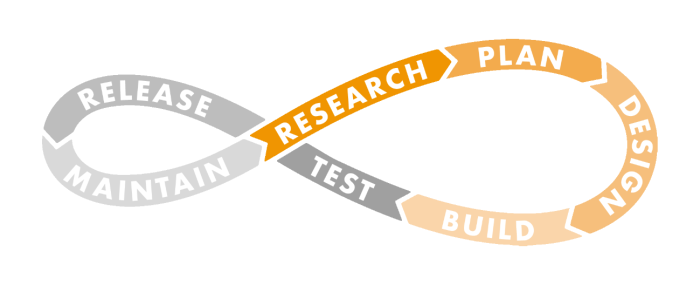
Our ongoing evolution is structured as a cycle rather than a series of fixes. The Infinity Development Cycle is a seven-stage loop that starts and end with listening to our users.
1. Research: The cycle begins in communications with the people who use the software. Our teams track industry trends and regulatory changes, but also actively implores direct input from users through virtual/in-person user group meetings, support tickets and surveys. These touchpoints are tailored to surface real friction in workflows or interface quirks before any design work begins.
2. Plan: Once research is gathered, it doesn’t automatically become a feature. The Software Development and Product Management teams evaluate the findings together, analyzing which enhancements would deliver the most value to the widest number of users, prioritizing a list of items for the next release, and staying tuned in to the needs of the organizations and agencies that use our platform.
3. Design: With priorities set, the Development Team translates business requirements into concrete workflow and featured frameworks. While at the same time Product Management team reviews the updates or enhancements to confirm they will function as intended and satisfy the need that triggered the request.
4. Build: Only after the design has been validated does the Software Development team begin coding. What agencies eventually see on the front end represents the result of collaborative research, planning, and design.
5. Test: Before anything reaches production, updates go through multiple rounds of testing. This includes technical testing (does the code work as written?), business testing (does it deliver the intended outcome efficiently?), and dedicated quality assurance review. Updates can also go through preemptive releases to early-adopter agencies and organizations, allowing us to see how the software is used and functions in the hands of real users. This layered approach is designed to catch both coding errors and functional gaps, ensuring the software not only runs correctly, but addresses the issue it was built to solve.
6. Release: Once testing is complete, updates move into the production schedule, pairing each release with a detailed release document, published on our training platform eVero Ed. Along with email communications that summarize the benefits and guides users toward training sessions and written resources. Ensuring agencies understand not just what changed, but why it impacts their daily operations.
7. Maintain: Our team continues monitoring usage patterns and system health after a feature goes live, watching for recurring issues or vulnerabilities. Just as we did initially, we request and receive user feedback on the new functionalities and enhancements.
This structure reflects an ideal understanding of how software should relate to the individuals it serves. Agencies working in I/DD services, self-direction, fiscal intermediation, and related fields operate under constantly shifting regulatory and operational pressures. A platform that can only respond on a fixed schedule forces agencies to build workarounds while they wait for the next major release. By contrast, a continuous cycle that loops user feedback directly into its research and planning allows the platform to adapt with the agencies and organizations, rather than trail behind them.
Our most recent updates have ranged from AI-assisted document translation and text enhancement tools to expanded audit tracking for assessments, to a dedicated Vendor Management module, to refinements in billing validation and EVV (Electronic Visit Verification) tracking. These are not isolated features, they represent the accumulated output of research conducted through user groups, support tickets, and surveys. Filtered through prioritization and validated through design reviews that is confirmed through testing, month after month, release after release.
Perhaps the most important implication of our development model is the relationship between agencies and organizations that use our platform. Traditional software often positions the vendor as a company that sells a finished product and the customer as a recipient receiving occasional updates. Our development cycle prioritizes agencies as active participants in shaping the roadmap and platform. Their feedback is built into the process at both the beginning (Research) and the end (Maintain) of every cycle. For agencies navigating an environment where regulatory and operational demands rarely stay still, this built-in responsiveness isn’t just a development philosophy, it is a practical necessity.
Learn more about eVero and our approach to the development process on our website: https://www.evero.com/software-development/