


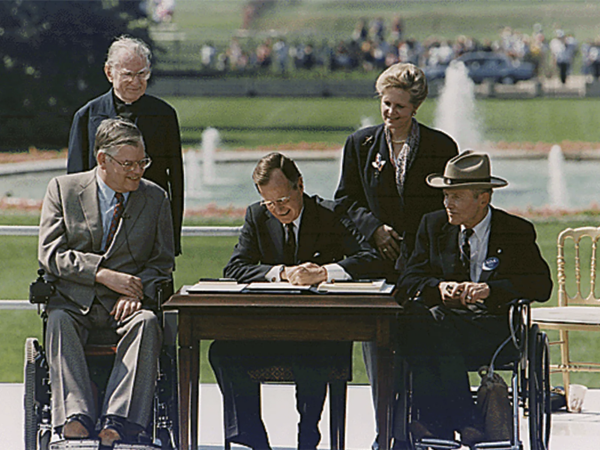
People with disabilities make up the largest and most diverse minority group in the United States, representing all abilities, ages, races, ethnicities, religions, and socio-economic backgrounds. It is estimated that 1-in-4 adults in the US have some type of disability, so it’s no surprise that a movement of Disability Pride has emerged and expanded since the act was signed in 1990.
The Americans with Disabilities Act of 1990 (ADA) is a landmark U.S. civil rights law that prohibits discrimination based on disability, extending protections similar to those the Civil Rights Act of 1964 gave based on race, religion, sex, and national origin. Unlike that earlier law, the ADA also requires employers to provide reasonable accommodations and sets accessibility standards for public spaces, transit, and communications. Its roots trace back to the Rehabilitation Act of 1973, which banned disability discrimination but only at federally funded institutions, leaving major gaps. Virginia’s 1985 Virginians with Disabilities Act served as an early prototype, and in 1986 the National Council on Disability’s “Towards Independence” report formally recommended comprehensive federal legislation, leading to a bill introduced in Congress in 1988. Bipartisan support grew through 1989, however, business groups and some religious organizations opposed the bill over cost concerns, and shortly before passage, activists staged the “Capitol Crawl,” pulling themselves up the Capitol’s steps to pressure lawmakers into action.
Congress passed the final bill in July 1990, and President George H. W. Bush signed it into law on July 26, 1990, declaring it would tear down “the shameful wall of exclusion.”
The ADA is organized into five titles:
(I) Employment
(II) Public Services
(III) Public Accommodations and Services by Private Entities
(IV) Telegraphs, Telephones, and Radiotelegraphs
(V) Miscellaneous Provisions
In 2008, after court rulings had narrowed who counted as “disabled,” President George W. Bush signed the ADA Amendments Act, broadening the definition and reversing those restrictive precedents, with changes taking effect in 2009. Since then, the ADA has driven major improvements in accessibility and shaped numerous Supreme Court cases, while debates continue over its economic impact, its application to websites and digital spaces, and persistent employment and wage gaps for people with disabilities.